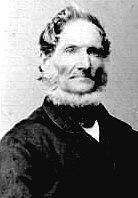
Picture of Edward True, Jr.
Husband:
Edward True, Jr. Born in Fayette, ME, 15 July 1799.
Died in Hope, ME, 18 November 1871; buried as was his wife in the Hope Grove Cemetery, Hope, ME.
Father: Edward True.
Mother: Molly French.
Family tradition says that our ancestor, Edward True, Jr., was a peddler selling from a horse drawn wagon pots, pans, pails, large milk pans, and other items made out of tin. Perhaps plying his business is how he came upon Hope Corner and decided to settle there.
In 1831, Edward True, Jr., and his business partner, Joshua Peirce bought the Wade Sweetland holdings in the northeast area of Hope Corner, ME. They also bought other pieces of property, such as, in 1833, a quarry site at Smith's Mills near what is now North Appleton and, in 1834, Mr. Blood's cooper store and land with the exception of the house thereon in the southeast area of Hope Corner. In 1832, before they completed the purchase of the land, either they or someone else established a general store on the cooper shop site. About 1835, Edward, Jr., bought out Peirce's interest in the cooper shop site general store and Peirce kept the businesses and the home/inn in the northeast corner. Edward, Jr., ran the general store with his brother-in-law, Lyman Smith, husband of Martha (Payson) Smith, as his partner until Smith died at a young age in 1847 and Edward, Jr., became the sole owner. Later, he established another business, making shoes and boots, either on the same site or in the building which housed the general store.
Edward True, Jr., with a great deal of hard work and constant attention to detail, prospered in his business life in Hope Corner. Their home was on the lot next to the store and was bought by Edward, Jr., probably around the time of his marriage. It faced the back of the store, was across the street from the church, and is the same house that is now the Church Parsonage. It was occupied together by the True and Smith families in the early days. The first floor had two rooms with a small hallway between containing a staircase which lead to two bedrooms under the eaves on the second floor, one on either side. Eventually, this home was occupied only by the True family. A cape cod style house, it was enlarged by at least one addition to accomodate their growing family. It has been called the "old homestead" for as long as we can remember. Here, Edward was able to give his children a good home. With his sound business sense, he was able to give them good educations and the means to travel. Here, he found his niche in life, with his wife raised a large family, and seemed especially suited to be of service to his community.
Olive King (Payson) True's daughter, Elizabeth (True) Spear, wrote about her, "I know of several who have called my mother a remarkable woman. When anyone was sick in the neighborhood mother was sent for." In Olive's obituary in the Rockland Courier Gazette, Nov. 2, 1886, p. 6, it was written about her that, "No other woman of this generation has ever filled so large a place in this community as she. Called upon constantly for aid by others she never was found slow to respond. None thought of her as nearing three score and ten, for she always retained her youthful ways and interest ..."
Edward, Jr., died intestate in 1871. The family was fortunate that the house and land were not their only assets as was the case with many other rural families: they had the store and a thriving boot and shoe business as well. It seems to me that it must have been dcided that the home and businesses were to be kept intact rather than to be sold for inheritance purposes. The Maine Register for 1874-75 lists for the town of Hope the "True heirs" as merchants (general store) and the "True heirs" as manufacturers (boots and shoes). At the time of Edward Jr.'s death, the oldest son, Edward Alonzo True, was being groomed to open a business in England in an arrangement with Salmon Willoughby Wilder, the husband of the oldest daughter, Rose. It fell upon the next oldest living son, LaForest True, almost 23 years old and working in Lawrence, MA, as a bookkeeper for his brother-in-law, Salmon Willoughby Wilder, to come home to run the businesses, no doubt with the help of his brothers and sisters, perhaps with the help of his mother. Probably some of the siblings worked for others both in Hope and in Camden whenever jobs were available. The shoe shop was reorganized in association with Addison Payson, uncle to the family, as the following attests: "Newly organized was the True and Payson shoe business manufacturing sewed and pegged boots which in 1872 was keeping nine men constantly employed according to a news item in the Courier Gazette." Hardy, "History of Hope," p. 141. The home was there for the use of the family which at the time consisted of the mother and seven of the nine surviving children, four of whom were underage. The younger children received their education through high school and some of them beyond that with Eugene, the youngest, graduating from Castine (ME) Normal School. All of the family members must have agreed on a formula of interest or like value on his or her inheritance which was worked out to each member's mutual benefit and satisfaction. Later, perhaps years later, the accounts were settled with each family member by LaForest. Finally, he owned the businesses and the family homestead in which he, in turn, brought up his own family.
Letters written before and after the death of their father told how the children helped each other find jobs. The store and shoe shop employed them at times. The oldest daughter, Rose, and her husband helped by housing them in their home while Rose's husband employed them at his paper mill in Lawrence, MA. LaForest, George, and possibly Herbert were hired as his bookkeepers off and on throughout the years. Mr. Wilder (Rose's husband was always referred to as Mr. Wilder or Mr. W.) helped the oldest son, Edward Alonzo, set up a business in Liverpool, England, collecting rags and shipping them to the states for use in Mr. Wilder's and other paper mills. This business, E. A. True & Co., prospered and supported the addition of the youngest brother to its ownership. Several members of the family visited England (and France) throughout the years, an opportunity not common to many people in those days.
Edward, Jr. and his wife Olive King (Payson) True had ten children, all born in Hope, ME:
* Edward Alonzo, b. 4 July 1836; d. in
the hospital in Newton, MA while living in Old Soldiers Home, Togus, ME,
27 Nov. 1919; m. in Leeds, Yorkshire, England, 9 April 1874, Jane Milnes.
* Rose Eaton, b. 25 Oct. 1838; d. Lowell, MA 21 April 1938; m. Hope, ME
29 March 1865 Salmon Willoughby Wilder.
* Mary Dearborn, b. 15 Aug. 1841; d. California 4 May 1887; m. Hope, ME
24 Nov. 1881 Alonzo Payson.
* John Augustine, b. 25 Dec. 1843; d. Hope, ME, 27 August 1858; buried in
his father's lot in Hope Grove Cemetery, Hope, ME.
* Elizabeth Coburn, b. 8 May 1846; d. Rockport, ME 11 Oct. 1943; m. 1 May
1878 Lewis Augustine Spear.
* LaForest Payson, b. 24 March 1849; d. Hope, ME, 3 March 1941; m. Rockland,
ME, 14 April 1887 Annie Katie Barnes.
* George Nathaniel, b. 13 April 1851; d. probably in Boston, MA 14 August
1938; m. 27 May 1902 Margaret E. Batty.
* Herbert Leslie, b. 5 Jan. 1854; d. Camden, ME, 22 May 1934; m. (1) Fortuna
C. Bowley; m. (2) Abbie E. Moody.
* Frances Payson, b. 3 Sept. 1856; d. Lowell, MA, 27 Dec. 1947; buried in
the Hope Grove Cemetery, Hope, ME. She did not marry.
* Eugene Payson, b. 19 July 1859; d. Wrentham, MA 17 Sept. 1940; m. in Wistow,
Yorkshire, England, 27 Dec. 1888 Annie Elizabeth Milnes.